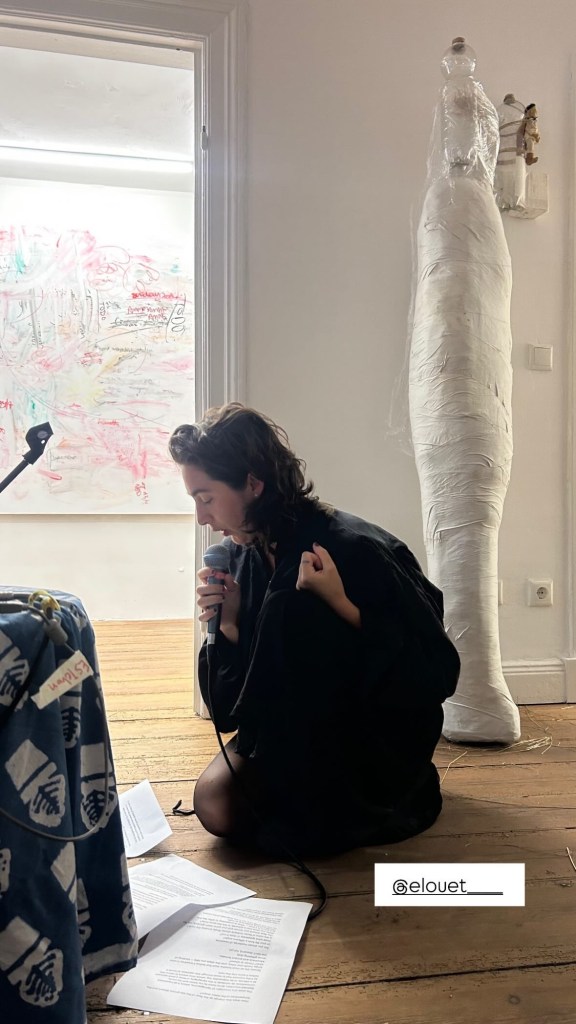
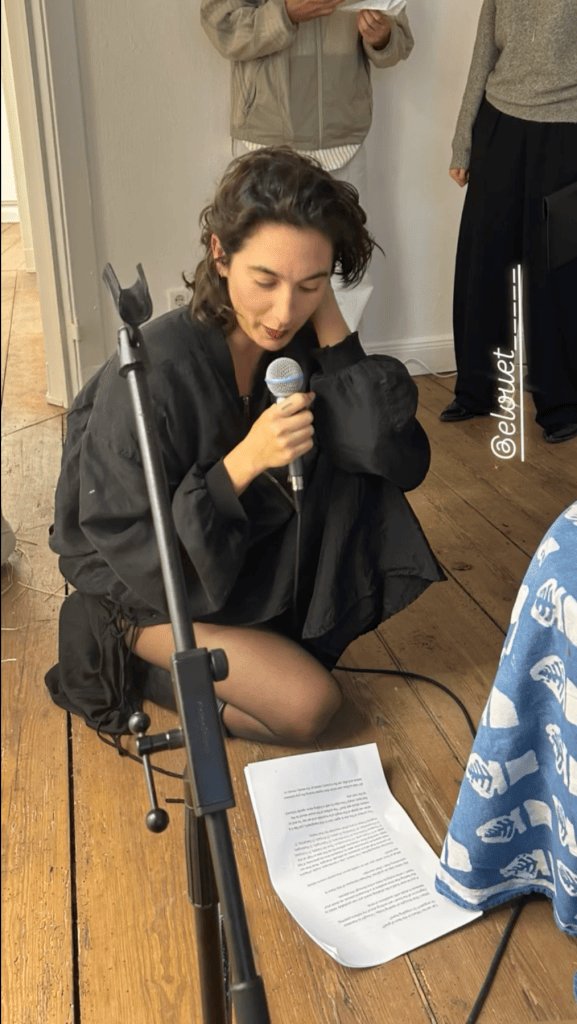
[Performative reading for the radio show “Zeit” in gallery Gruppe Motto; hosted by Sanna Leone and Luzia Cruz; broadcasted Sunday 20.09.2026 from Gängeviertel, Hamburg.]
/////////////////////////////////////////////////////////////////////////////////////////////////////////////////
Can we be Others in the face of grief?
Or anguish? Or crippling fears?
When I first thought of reading today, I thought to translate fragments of the book I am writing about my fathers passing, because it deals with questions of time.
If you’ve ever lived a life-shaking event you can probably relate to the feeling that time scatters in a thousand pieces, as does your heart. I write trying to trace a line through the pieces.
My father was an andinist. Perhaps because of this there is something that I often wonder:
What is time when you are at nearly seven thousand meters above sea level?
Time has topographies, I’ve heard. Like a landscape, made of layers of currents that vary in pressure as altitude changes. Now that we have quantum computers able to measure time so precisely, it has been said that time measures differently by the sea or high at the peak of El Huascarán, El Aconcagua, Ojos del Salado, El Cotopaxi, El Guagua Pichincha, El Chimborazo, El Tupungato, El Ausangate, El Chopicalqui, El Chinchey, El pisco, El Ampato, El Salcantay, El Huayna Potosí or any other mountain for that matter.
The surface of the sea is again zero in this topography, just like it is when we speak of the height of a mountain and we say “so and so meters above sea level”. The surface of the ocean would be the first layer, where Time slips by with a folding wave, rapidly followed by the next one.
Ah! Vast surface over which time ripples loosing the grip between before and after, yet the moment, steady as the waves, moves on.
How does this change as the floor of the sea grows distant?
The peak of a mountain: El Yannapaccha, where it all happened. In the topography of time, a peak appears as a silence, or an impossible fog, where time seems to stand still, as if the moment had to travel through this vastness, to know it before it turns into the next.
Slower, the air must breathe itself first before it breathes in your lungs, inside your mind, unto the steps you take — thinking of what? Closer to whom?
Morpheus and ancient females,
snow glittering dust,
you don’t descend, not yet.
Are you shown mysteries of mysteries?
or your life from a different angle?
Does wind speakeasy, or does it not?
Is the voice of those motherly stones finally enveloping the Earth?
The fiber around your bones and your joints seem glorious, not like when you stroll over a sidewalk, is this the same body?
Is it you or is it time — what it possesses — to differ like this?
Frontiers of time protecting its truth,
no one will speak of it, not in the language of the streets.
(Pause)
I was asking myself about time in this way, and about the landscapes I come from. In the crevices of those mountains my story is held. I’m so fond of its vastness.
The shimmering silver of the stones, the dry smell of dust — these places know me. I know them.
Now I am far from those landscapes where this grief is known. I listen instead to the silence over this heath, the crumbling walls, a distant roar.
In this land, are others Other to my grief?
Am I an Other to your suffering?
I must look into the eye of Anguish to I find theres is no Other to this feeling. I must sink into the depths of the ocean, where time again unravels and light goes from blue to black, learn to breath in such mystery to see I only see what is common to us all.
I’ve read recently “memory is the past illuminating the present”.
But I have found one has to hold memory as a torch for it to illuminate the present, the same as one learns to hold death ever so near to learn to live.
To really live, without letting the moment slip by untouched, untasted, death is the master, the pill against oblivion.
(Pause)
Us — an improvised group of five women — we sat one Monday night over a rug, outside in the terrace before the garden, in an opening of the trees where the sky is visible.
A rug, an ashtray at the center. A group of women. The ember of a cigarette becomes the torch, lit by inhalation and passed from one to the other.
We took turns to speak. Smoke flowed between us like novelty, never the same. We spoke of the current situation in this country, Germany, where we live. We spoke of drones, increasing militarization, the way things have led up to this state of much homelessness, ignorance, disgust, tiredness, numbness, desperation, fear, and a quiet murmur of nothing at all. Listening, it occurred to me “it must be difficult”.
Yes, it appears difficult to imagine possibilities when one is missing the stories of the those who paved through such designed numbness, insisting in freedom.
Their songs, their lament, their books and their portraits, where are they? Where are they really?
I imagine, if you are only taught guilt, get cornered into obligation, and exhausted by the moralizing lesson, what is there left? Where do your eyes turn? Isn’t the victory of Nazis perpetuated in this way? Aren’t fascist ideologies so easy to drip through the cracks when we sleepwalk?
I haven’t found a day in the year where people, us, anyone leans towards the silence that has been left.
Not a day in the year destined to the exercise of listening to what fills said silence (beyond discourse) to let this enter the body, move through it, so as to allow the experience to inform the mind and the choices, not from trained obligation, but from the very human faculty called memory.
So, I think “it must be fear” of what you, us, anyone might develop through such an innate ability.
And so it is replaced by performative politics of memory. And oblivion covers over the landscape, such a cozy quilt.
We know this, stories of communion and resistance, however little, fictional or real, have a pulling force in the psyche and in the body.
A rug and an ashtray, over which one can speak, at night, in the dark, under the sky. Slowly, by turns, so softly.
We spoke of our fears, we took turns to name them.
Mine, you can already guess it, is that we loose this torch, the dreams, the books, the courage with which we look at darkness and see the face of anyone, everyone, staring back.
That we come to a point where it is no longer important, no space for it. That we loose it without knowing we’ve lost it. Then I think we used to write engraving stone, now it is my hands over this keyboard and still, an invisible thread weaves itself through; the medium changes, the thread persists.
A bit like we may loose a loved one, yet their force — inspiring — remains; its in me, its here. I’ve tried to weave it through.
(Pause)
By the end, after we’ve all spoken of our fears in the face of Today, you can also guess it, something surprised me: fear hadn’t reproduced itself in our words like a crippling virus, leaving us jaded or disjointed.
Much on the contrary, the humanity in each one of us, what we care for appeared brilliantly, surrounding us. And then, here it is, we were not only not Others, but together.
Time has topographies, yes, and lengths. So, if I don’t make something out of the beauty of that moment: five women in a terrace over a rug, end of summer, speaking of Today, if I don’t try to break through time, even in terms of a couple of weeks, just by writing it here, what is the point?
(Pause)
Following this evening, I traveled away from Germany, to return a few days after. Once I was back on German soil, in the train destined to Hamburg-Altona, a very large number of young men in military uniforms boarded the train. Really, a very large number. Two are sitting in the row before me. After a few hours of travel, I can see through the separation between their seats what one of them is looking at on his phone. It was the myth of Narcissus:
The man in a military uniform holds, at the side of his crotch, a screen in which he sees a man in his same uniform facing the camera. The vertical frame ends before his face. He holds a black gun over a black table. He disassembles the gun, cleans it and assembles it back together.
This image summarised it for me. A man holds a mirror near his cock, to see himself holding another cock. Caressing it, checking its functionality, then neatly tucking it back in.
What is this? An image to reinforce his image? There would lie his weakness. A superficial one, of the surface.
What is yet to be discovered is whether we can hear our echoes, beyond Narcissus.
An echo comes from Before, an echo is sound, so much more rebellious than an image. So much more difficult to tame. I say, let it be loud.
/////////////////////////////////////////////////////////////////////////////////////////////////////////////////
/////////////////////////////////////////////////////////////////////////////////////////////////////////////////
 Elisa Juri